
Basel's Iconic Buildings: Basler Rathaus
- Antara Das

- 45 minutes ago
- 6 min read
Basel's iconic red Rathaus (city hall) has a remarkable history. This 500 year old historic landmark prominently spans Basel's Marktplatz, and even today actively houses all the meetings of the cantonal parliament and the government of Basel Stadt. There is much that can be said about the Basler Rathaus, but this article gives a short summary of some of the highlights.

Early Beginnings
The Basler Rathaus has gone through extensive architectural and functional changes through its history. Early records show that a building on this site (not the red structure you see today), was used for city governance as early as the 13th century. Until the 16th century it functioned as a Richthaus (courthouse). After the 16th century, city records show a gradual shift from the usage of Richthaus to Rathaus, though the terms were used interchangeably for a long time. As the number of councillors and guild members within the government grew, the political importance of the Rathaus did as well. During these times it served many purposes including a marketplace, warehouse, court, prison, fire station, document archive and banqueting hall.
This all changed in the mid-14th century. The building was impacted, as was the rest of Basel, by the infamous Basel earthquake (with an estimated magnitude of 6.6) in 1356. This resulted in extensive damage and many records and documents were lost.
Basel Joins the Confederation
While Basel was rebuilt, Switzerland evolved and formed into a country. In 1501 Basel joined the Swiss confederation. This marked the start of a new era and in 1503 the Grand Council decided to construct a new building to mark the city's decision to join the confederation. The construction took place from 1504 to 1514 and was carefully planned and designed, taking inspiration from medieval palaces in northern and central Italy.
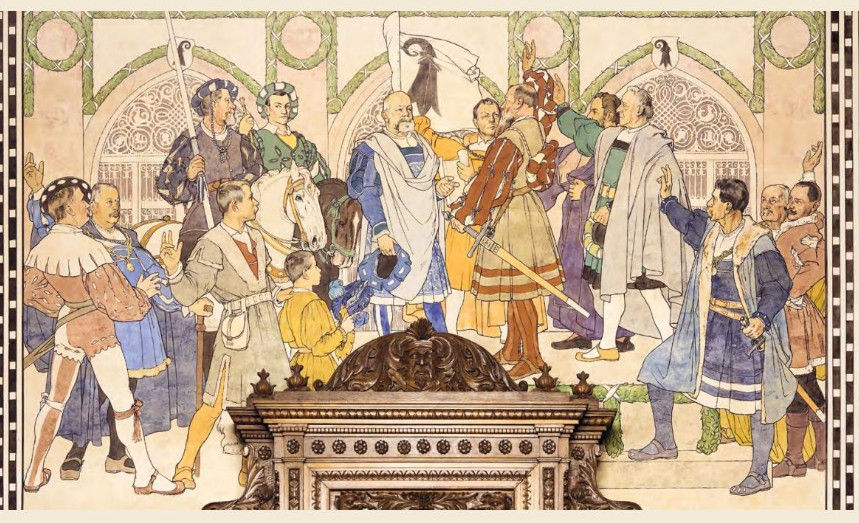
Basel becoming part of the Swiss confederation is celebrated throughout the Rathaus and you can see this in this mural painted by the artist Emil Schill, located inside in the Grand Council Chamber. The mural displays the ceremony of Basel entering the Swiss confederation. The artist, Emil Schill incorporated the use of live models, which added a unique emotive layer to the celebration. Additionally the Swiss confederation is also displayed by the coats of arms of each canton on the front facade.
A Distinctive Colour
While Rathaus is the name in standard German, in local Swiss German dialect it is often called Roothuus. Many younger Swiss German speakers may assume that this comes from the colour of the city hall because the first part of the word Root can refer to red (Rot). However Root is actually just the dialect form of the standard German word Rat, meaning council.
The distinctive red sandstone used for the Rathaus comes from quarries northeast of Lörrach in a village called Steinen. The sandstone was transported via the Wiese river to Basel. You may notice differing shades of red across this structure and this is because it is also painted with different shades of red mineral oil paints which tend to fade with the weather.
The Tower

Although the lower part of this iconic red building was built in the 16 century, the distinctive tower on the right hand side was not added until 1900. The Tower was built to accommodate the growing needs of the city, but the decision to build it came with some controversy Many citizens were concerned about the cost as well as the suitability of such a structure for a Swiss town hall. This led to a public vote, which as you can see was in favour of this striking bold tower.
Art
As you look around the Rathaus, you will start to notice there are scenes from ancient history, as well as the bible painted throughout. These were used to illustrate the a distinction between good and bad conduct, standing as a reminder for the councillors and judges to conduct decisions in the right manner. It also offered a way for the citizens at the time to see these images of justice as an example of how the government functioned.
One such mural is the fresco was done by Hans Holbein. This painting, (now residing in the Kunstmuseum) shows Rehobboam, the son of Soloman, who led an arrogant government which led people to rebel. This mural stood as a reminder to the councillors to govern in a wise and godly manner for the people.


The Rathaus has many other historical references. Another example being the bronze plaque from 1537 located at the entrance. This plaque commemorates the intense flooding which occurred in Basel in 1529 and 1530, showing the water level that was reached when the Birsig river overflowed.

Inside the Rathaus courtyard you will notice the statue of Lucius Munatius Plancus, which was sculpted by Hans Michel. He did this as a thank you to Basel, because when he arrived in the city, he was provided citizenship free of charge. He was so impressed that in return he sculpted this statue. This statue displays a famous Roman general, whose role in Basel is often confused. Many believed him to be the founder of Basel, but the records and tombstone inscriptions do not confirm this. He was however the founder of the roman colony of Augusta Raurica, in the present day Augst, a municipality in in Basel Land.

Another fascinating symbol inside the courtyard of the Rathaus is a mural of two Great Danes. The story behind this mural is that during the renovation of the town hall in the 1900s, there was decision to house the department of finance within the Rathaus and the Great Danes represent a symbol of protection to guard the state treasury.
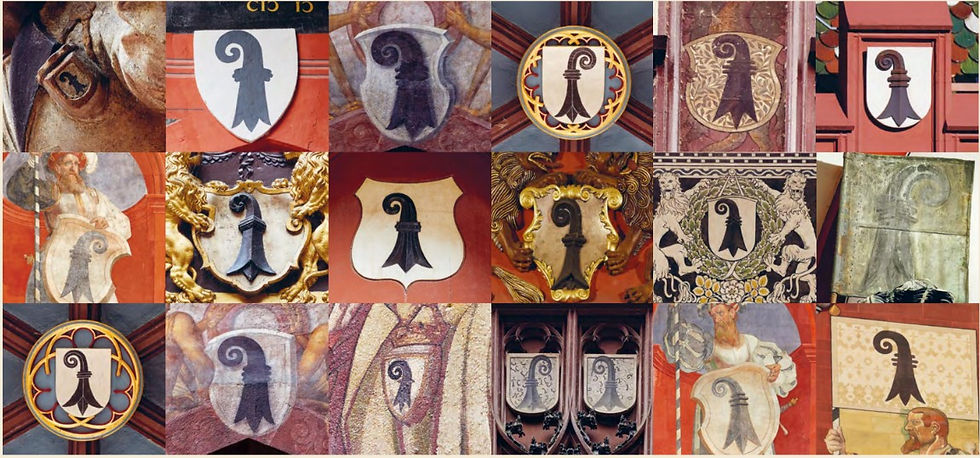
Basel's identity as a canton, is adorned across the Rathaus with the ever present Baselstab (Basel Staff) which is the stylized version of the bishop's crozier. This Baselstab can be found across many sculptures, carvings, and murals around the Rathaus. An impressive collection of curated images of the Baselstab around the Rathaus can also be found in Kennst du das Basler Rathaus by Oswald Inglin.
Architecture
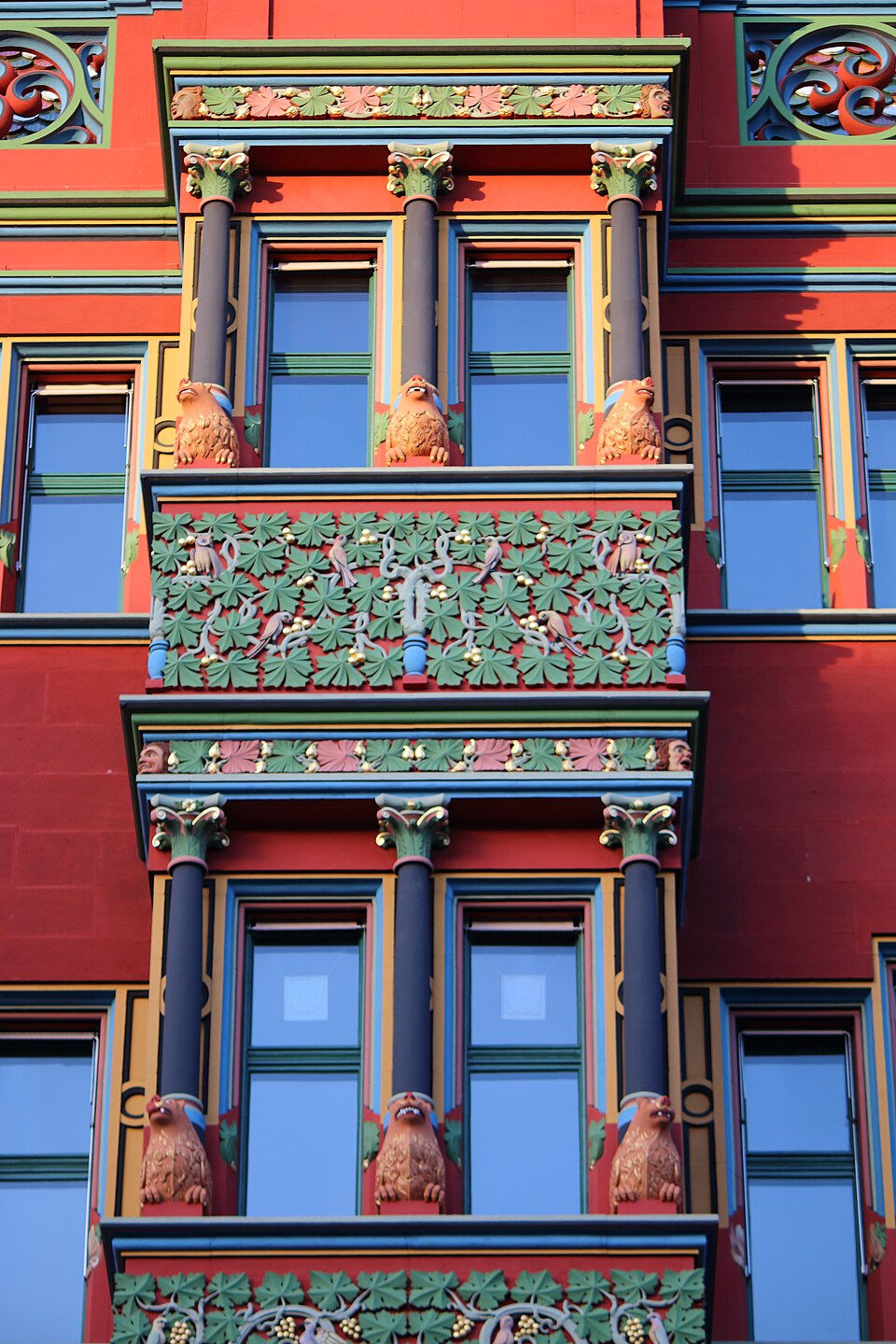
The Rathaus incorporates a blend of Neo-Gothic and Neo-Renaissance elements across its murals, carvings and structures. For example the balcony is designed in the Neo-Gothic style with Art Nouveau elements of foliage.

In terms of the Neo-Renaissance elements, the style is seen in the classical architectural features such as the fluted columns with ionic capital and also the decorative fruit motifs carved above. Furthermore the central figure of Justitia (lady of justice) is characteristic of the classical revival.
The courtyard has slightly pointed Late Gothic arches embellished with renaissance murals and motifs. Together these elements blend seamlessly to give the Basel Rathaus a striking and unique presence
Rathaus Functions
To understand the Rathaus in Basel, it is important to understand how the Swiss government functions. Switzerland functions with a government structure that consists of three levels: federal, canton and the commune.
Each canton works through the approval of the government, parliament, courts and the citizens. The Grand Council in Basel conducts all the cantonal laws, supervises the government, conducts administrative work and also decides the levels of taxation which requires the approval from the parliament. The Grand Council is split into 13 committees that advise on the legislation and expenditure. This plays a major role in enacting changes.

One important thing to note is that in the earlier days, the Grand Council was composed of only men and women were only granted access in 1966. This change triggered a notable event, and in 1975, the Grand Council elected Dr. Gertrud Spiess as the first female president, one of 14 women elected that year. She was also Basel's first female National Councillor. A bronze portrait of her stands in the entrance hall to the Grand Council Chamber to commemorate her achievements.
Further Exploration
This article is only a short survey of some of the more interesting aspects of the Rathaus. To delve more deeply into the extensive history of this building, with more stories behind the murals, sculptures and the overall purpose, you can take a 30 minute guided tour offered by Basel Tourism in English and German. Additionally, there are some excellent books on the subject: Das Rathaus in Basel by Martin Möhle is available in German, French and English as well as the previously mentioned Kennst du das Basler Rathaus by Oswald Inglin. This book provides comprehensive history by detailing everything from the outside to the inside of the Rathaus with accompanying illustrations.
The Basel Rathaus stands as a powerful symbol of centuries of political change and serves a vital role where citizens and the government shape the city's future. I hope this article has peaked your interest is some of the city's architecture and that you will be inspired to learn more.
Sources
Antara Das

Antara is from India and has lived in Basel since 2013. She is currently studying psychology in the UK.


Comments